Professional & Knowledgable Law Team

Thursday, December 22, 2011

Taxation rules for NRIs

Here are some exemptions and tax-saving tips that non-resident Indians can avail of 
Juggling finances in one country is bad enough; having to do it in two can be baffling . When it comes to filing taxes, NRIs find themselves in this unenviable position as the Income tax rules for NRIs are different from those that are valid for residents. Here's a quick guide to NRI taxation. 

Taxes applicable: 
Income which is earned outside India by an NRI is not taxed here. An NRI doesn't have to pay tax on the interest income in a non-resident external (NRE) account or foreign currency nonresident (FCNR) account. But you must be careful about taxes you pay in your new home country as some income that is exempt in India is taxed abroad. 

Filing returns: 
There is no need to file income tax return if you don't have any income here. However, if the income accruing in India through capital gains, rent, dividend or interest is beyond the threshold limit, you will have to file tax returns. Here, too, you can claim certain deductions. So, for 2011-12 , an NRI (male, below 60 years) whose income exceeds 1.8 lakh and a person above 60 years who earns more than 2.5 lakh should file returns in India. 

Investments 
If, as a resident, you made some investments and redeemed them after becoming an NRI, these will be treated differently . For instance, NRIs cannot extend the tenure of their PPF account. Capital gainslong-term or short-term-will be applicable when you redeem/sell your past investments. If you sell shares that are listed on a recognised stock exchange in India after holding them for more than a year, you will not have to pay tax on the capital gain provided the securities transaction tax has been paid. 

Tax-saving tips 
NRIs can save on these taxes by investing in pension plans, life insurance policies and tax-saving mutual funds. The repayment by an NRI towards principal amount of home loan is eligible for deduction up to 1 lakh, while the interest payment is also allowed as a deduction. NRIs can also buy a health insurance policy here for themselves, their family and dependent parents , and claim deduction up to 35,000 for the annual premium paid. If you have been repaying an education loan, the interest paid can be claimed for deduction . NRIs can put their money in tax-saving bonds too. Capital gains up to 50 lakh earned from selling a capital asset can be invested in bonds of NHAI or REC. Investment income foreign currency bonds, are subject to tax at 20% as against the maximum rate of 30%. NRIs can invest in such assets and benefit from the lower rate. Also, an NRI can avail of lower tax rates on interest income through beneficial treaty provisions.

US call centre Bill has slim chance of becoming a law


A Bill that seeks to bar US firms that outsource call centre jobs from receiving federal grants and loans has created uproar in India, but is nowhere close to becoming a law.
The Bill, introduced by Congressman Tim Bishop, a New York Democrat, has been referred to four committees in the House of Representatives: Energy and Commerce, Oversight and Government Reform, Armed Services, and Education and the Workforce. Bishop introduced the legislation earlier this month.
The US Call Centre and Consumer Protection Act is cosponsored by two Republicans, Congressmen Dave McKinley of West Virginia and Michael Grimm of New York, and two other Democrats, Congressmen Mike Michaud of Maine and Gene Green of Texas.
“We are hopeful that the hearings may be forthcoming next year due to the legislation's bipartisan support,” Bishop’s spokesman Oliver Longwell told The Tribune.
Congressional sources said the Bill stands little chance of becoming a law. The Bill requires overseas call centre employees to disclose their location to consumers in America and gives customers the right to be transferred to a US-based call centre on request. The Bill has the support of the 700,000-member Communications Workers of America.
“It is common sense that we should not be rewarding companies that ship jobs overseas, while millions of qualified Americans are looking for work,” Bishop said. “Taxpayer dollars should only be used to give incentives to good corporate citizens who create American jobs,” he added. The Bill would also require the US Department of Labour to monitor firms that send call centre jobs overseas.
These firms would be ineligible for any direct or indirect federal loans or loan guarantees for five years. Customer service/call centre employment in the US has dropped from 5.2 million in 2006 to 4.7 million in 2010 as the US firms have relocated operations overseas in a bid to cut their own costs, according to the Communications Workers of America.
India has been one of the main beneficiaries of outsourced jobs. Outsourcing has become a contentious practice as the US economy has stalled.
“If you are frustrated by dealing with call centres that are located overseas and having to worry about the security of your personal information, this Bill will give you a choice to deal with American workers who must comply with American laws,” said Michael Gendron of Communications Workers of America.
THE FINE PRINT
  • No direct or indirect federal loans or loan guarantees for five years for American firms that outsource call centre jobs
  • Bill designed to limit identity theft threat at foreign call centres
  • It requires overseas call centre employees to disclose their location to consumers in the US and gives customers the right to be transferred to a US-based call centre on request

Tuesday, December 20, 2011

HC verdict on Sehajdhari voting rights case today


Chandigarh, December 19
The Punjab and Haryana High Court will on Tuesday deliver verdict on the Sehajdhari Sikhs voting rights issue.
A three-Judge Bench of the High Court is scheduled to pronounce the orders on a bunch of three petitions filed by the Sehajdhari Sikhs Federation and other petitioners.
They are seeking directions to the Union of India and other respondents for quashing the impugned notification issued in on October 8, 2003.
The notification debars Sehajdhari Sikhs from voting in the SGPC elections was issued.

HC rap for Punjab rights commission

Says SHRC only a recommendatory institution

Chandigarh, December 19
Finding fault with an order of the Punjab State Human Rights Commission against a DSP and two other police officials, the Punjab and Haryana High Court has ruled that the commission is only a recommendatory institution. It does not have the jurisdiction to reject defence version furnished by the police officers.

The ruling came on a petition filed by DSP Balwinder Singh, Barjinder Kumar and Sanjeev Kumar Goel against the State of Punjab and other respondents.
In the petition placed before the Bench of Justice MM Kumar and Justice Rajiv Narain Raina, challenge was thrown to the order dated November 12, 2009, passed by the Punjab State Human Rights Commission.
In its order, the Commission had rejected the defence pleas of the three police officers and recommended to the State Government to initiate department action against them. An interim compensation of Rs 25,000 was also recommended for Vishal Kumar, the victim of police harassment.
Challenging the order, counsel for the petitioner submitted: “Once the commission decides that the defence raised by the three petitioners was rejected, this would certainly prejudice their rights before the regular courts of law where they may have to face criminal or civil proceedings.” The counsel added the rest of the order was recommendatory and there could not be “any possible objection”.
After hearing the rival contentions, the Bench asserted that it was of the view that the submission made by the petitioner’s counsel on the offending portion of the order deserved to be accepted.
“Once the commission is found to be a recommendatory institution by the Division Bench of this court and the commission is only to act as a catalytic body, it would not have any jurisdiction to reject the defence version posed by the petitioner before the commission.”
“If such a course is adopted, it would amount to adjudication of the rights of the parties and their case before the regular courts might be prejudiced…. The following portion of the order is set aside: The commission rejects the defence pleas of the three police officers. The writ petitions are partly allowed. However, rest of the recommendations would stand”.
The rulebook
  • The commission had rejected the defence pleas of the three police officers in a case
  • It also recommended to the State Government to initiate departmental action against the trio
  • The High Court, however, ruled that the commission did not have the jurisdiction to reject defence version as furnished by the police officials
  • The ruling came on a petition filed by DSP Balwinder Singh, Barjinder Kumar and Sanjeev Kumar Goel against the State of Punjab and other respondents

Monday, December 19, 2011

Cabinet clears Food Security Bill, to be tabled in Parliament this week

NEW DELHI: After a prod by Congress chief Sonia Gandhi, the Cabinet on Sunday cleared the National Food Security Bill at a specially convened meeting to table it in Parliament this week.

The bill, meant to provide subsidized foodgrains to people, brought to the Cabinet by food and public distribution minister K V Thomas, was approved without a hitch in a meeting that lasted under an hour.

The bill, which the UPA will table in Parliament in the hope of gaining some political dividend in the crucial Uttar Pradesh elections, seeks to cover 75% of the rural population and 50% of urban population in the country. Initial estimates suggest that the food subsidy bill could be upwards of Rs 1 lakh crore.

A minimum of 46% of the rural population and 28% urban population will get 7 kg of foodgrains per month per person. Rice would be provided at Rs 3 a kg, wheat at Rs 2 and coarse grains at Rs 1 a kg.

The rest of the targeted population would get 3 kg of grains per person per month at half the minimum support price offered to farmers by government during procurement. Existing nutrition and select social security schemes would also be brought under the legislation as an entitlement.

After having ensured clearance for a bill seen as the Congress president's pet project and a key element in the party's strategy for 2014 general elections, Thomas said, "With this, we fulfill our commitment to the people of India made first in the Congress manifesto in 2009."

Thomas met PM Manmohan Singh on Sunday just ahead of the Cabinet meeting and explained in detail the proposals as well as responses that had been elicited from various states. Thomas explained the financial ramifications of the bill to the PM as well as the foodgrain requirements and storage capacities that would need to be built up in the coming days. The inclusion of existing social security and nutrition schemes under the bill was also discussed with the PM with the cabinet secretary and V Narayanasamy, minister of state in the PMO.

The fact that Congress wants the bill tabled as soon as possible was evident when minutes of the Cabinet meeting and the final decision were communicated within minutes of the meeting's end.

The total number of beneficiaries to be covered by the bill would depend upon the results of the delayed Socio-Economic and Caste Census currently underway. While the government had moved closer to the recommendations of Sonia Gandhi-led National Advisory Council, it has left the door open to play with the absolute numbers through the use of 'deprivation parameters' in the census data.

Saturday, December 17, 2011

ICICI Prudential Life Insurance Company told to pay Rs 90,372


Chandigarh, December 16
The District Consumer Disputes Redressal Forum-I, while rejecting the claim of a Sector-8 resident over the foreclosure amount charged by ICICI Bank, has directed ICICI Prudential Life Insurance Company to pay Rs 90,372 along with 12 per cent interest per annum from the date of filing of the complaint till its realisation.
The forum, comprising president PD Goel and member Madanjit Kaur Sahota, also directed the insurance company to pay Rs 10,000 as costs of litigation to the complainant.
The complainant, Japji Kaur Cheema, had submitted that she had taken a housing loan of Rs 1,02,68,000 from ICICI Bank and was issued a life insurance policy by ICICI Prudential Life Insurance Co. as part of the loan agreement against one-time premium of Rs 2.68 lakh.
Later, a sum of Rs 19,474 was refunded to her out of the paid premium. She decided to foreclose the loan but the bank charged Rs 2,30,227 as prepayment/foreclosure charges from her, which was paid under protest as there was no clause in the loan agreement with regard to it.
She further averred that she surrendered the insurance policy with the request to the bank to refund the amount of premium but despite her repeated requests, only Rs 1,49,605 was refunded.
The bank, while taking some preliminary objections, said as per the agreement, they were supposed to charge 2 per cent amount as the foreclosure charges.
The insurance company denied that it was mandatory to obtain the insurance policy. It has been stated as per the terms and conditions of the insurance policy, if there is full repayment of the loan, then the policy holder is entitled to the surrender value, it claimed.
In the present case, after surrender of the insurance policy, the amount of Rs 1,49,505 was credited to the account of the complainant.
It was further pleaded that the complainant enjoyed the life cover till the policy was cancelled.
The forum, while giving relief to the bank observed that the insurance company had not produced on record any terms and conditions of the insurance policy that in case of full repayment of the loan, the policyholder was entitled to the surrender value.

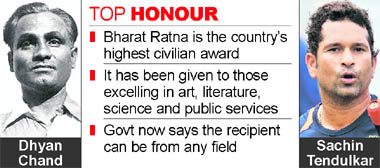
Bharat Ratna now open to all, including sports icons


New Delhi, December 16
The government has modified the eligibility criteria for the Bharat Ratna paving the way for sportspersons such as hockey legend Dhyan Chand and cricket icon Sachin Tendulkar to be conferred the country’s highest civilian award.
The new rules, providing for eligibility of persons excelling in fields other than art, literature, science and public services for the Bharat Ratna, were notified on November 16, Sports Minister Ajay Maken told reporters here on Friday.
“I wrote a letter to the Home Minister on April 15. The Prime Minister and the Home Minister have very kindly agreed to change the norms. Now, the government has notified that for performance of highest order in any field of human endeavour Bharat Ratna could be awarded,” Maken said. He said the decision has paved the way for any sportsperson to get top award. The move comes amid clamour for giving the honour to Tendulkar for his outstanding contribution to cricket.
“For me as a Sports Minister, this is one of the biggest days for Indian sports and next biggest day I think will be the day when some sportsperson will be awarded the Bharat Ratna,” Maken further said.
Maken said Dhyan Chand and Tendulkar were the top contenders for the award.
“Both of them I think should be the top contenders. Ultimately, the decision has to be taken by the Prime Minister. The Prime Minister takes the decision and recommends it to the President,” he said.
The Bharat Ratna was instituted in 1954. Any person without distinction of race, occupation, position or sex is eligible for this award.
The number of annual awards is restricted to a maximum of three in a particular year. On conferment of the award, the recipient receives a Sanad (certificate) signed by the President and a medallion. So far, 41 people have got this award. The first three Indians, who received the prestigious award, were Chandrasekhara Venkata Raman, Chakravarti Rajagopalachari and Sarvapali Radhakrishnan in 1954.
There is no written provision that the award should be given to Indian citizens only. The award has been conferred on a naturalised Indian citizen Mother Teresa (1980) and to two non-Indians - Khan Abdul Ghaffar Khan and Nelson Mandela (1990). Pandit Bhimsen Joshi was its last recipient.